Fundamentals of Developmental Friendship
September 14 to November 30, 2026 · Mondays 3:00-5:30 PT
Twelve weeks · Twelve spots · Online on Zoom · $1,500
Fundamentals of Developmental Friendship is a 12-week online cohort where you'll learn tools and frameworks that will support you in your development, and in creating developmental friendship in your life.
It will run weekly on Mondays at 3:00-5:30 PT, beginning Monday, September 14th, 2026.
What is developmental friendship?
We think of developmental friendship as a friendship that supports each individual in developing into whole, contributing human beings with thriving relationships.
These friendships are based in care and truth. We deeply care about each other and how we show up in the world, and because of that we bring in honest and truthful reflections and feedback.
We think friendship is essential to our development, and the Buddha thought so too.
For more, see this essay by Kedar: Read the essay
In early buddhist scriptures, Ananda had this realization about the importance of friendship on the spiritual path that he shared with the Buddha:
“Venerable sir, this is half of the holy life, that is, good friendship, good companionship, good comradeship”
“Not so Ananda! This is the entire holy life, Ananda, that is, good friendship, good companionship, good comradeship.”
What is development?
In our view, we think of a few main axes of development that are all mutually supportive.
Cultivating Awareness
Awareness is cultivating the ability to clearly see what is happening in our minds, bodies and relationships, and be able to start making a different choice.
We have many different mind-body postures that we take in different moments. Imagine you're writing an essay for school, and it's really important that you get a good grade, and you're trying really hard. Your chest and arms might be tight, it might even feel like somehow your thoughts are tight. There might be tension inside your forehead. Contrast that with the feeling in your body and mind of writing an email to a close friend who's curious to learn something you're passionate about. Your chest is relaxed, there is a warm feeling going through your body, words are flowing, there is a sense of childlike wonder bubbling in your head.
These mind-body postures determine how we do everything, and often we're either completely unaware of the posture we're in, or we don't feel that we have any control over them.
If I have been clenching my fist my whole life, I might try to use my other hand to pry my fingers open. Now my two hands are locked in a battle. But if I can feel what clenching my fist feels like, I can start to learn how to unclench it from the inside. Becoming aware of our unconscious postures can feel like this.
Cultivating awareness has many aspects. Having an ongoing awareness of the sensations of my body and how I'm reacting to them. Awareness of my surroundings, awareness of how my attention is being pulled in different directions, awareness of what implicit beliefs I'm bringing into a situation and the stories I'm telling about them.
Some other words you might use could be: awareness, presence, self energy, flow, spontaneity, freedom, lucidity, spaciousness, connection to spirit, sacredness. This axis of development is learning to live more and more from that (whatever you call it) on an ongoing basis, in more and more situations.
Healing
We all have emotional baggage and old familiar habits of thinking and feeling. We can call it trauma, karma, limiting beliefs, relational wounding, resisted emotions, triggers, however we want to relate to it. These can be almost always-on patterns or can be evoked by particular situations. In either case, our reaction to this material is what takes us out of presence.
Healing is about working with specific thought patterns and triggers, so that they lose their magnetic pull that takes us out of presence.
With healing, we are not actually trying to fix ourselves, because some part of us was never broken to begin with. Underneath the wound, underneath the pattern, there's a wholeness the wound never touched. Healing is less about repairing damage and more about finding that ground and learning to rest in it while the hard material moves through us. From that place the old patterns start to loosen. And what we find in that ground isn't blank. It has qualities.
Nurturing positive qualities
Compassion, Power, Trust, Clarity, Intuition, Creativity, Equanimity, Generosity, Determination... These and many more qualities exist as energies that live in each of us, that express differently in different situations.
Developing into mature human beings involves recognizing the qualities that are inherent within each of us and to evoke them when called for in certain situations, letting go of the blocks we have around those qualities, and intentionally nurturing them.
How do we feel simultaneously a sense of power and of love when we need to set boundaries with loved ones?
How do we rest into a sense of clarity when we're needing to make decisions in which there is much uncertainty?
How do we cultivate a felt sense of trust and equanimity that will enable us to take actions that feel scary?
Our Methodology
We have a particular methodology that we believe lends itself to powerful group process, as well as 1:1 developmental friendships.
The main goal of this twelve week course is to learn this methodology that will prepare you to be in powerful developmental friendships. It isn't cognitive learning, it's embodied, more akin to learning a martial art than to learning a psychological theory. You'll be learning by practicing, and through that practice you'll see your awareness grow and your relationships change for the better (hopefully).
Emotional Surfing
Emotional Surfing is a micromeditation technique for cultivating awareness, and for becoming aware of and developing choice in our mind-body postures. It involves finding an underlying wholeness that's always available, which gives rise to a sense of fundamental okayness, allowing us to release our reactive patterning. Emotional Surfing is inspired by Tibetan Buddhist and Realization Process meditation practices.
You'll be learning to use Emotional Surfing in your daily life. It will also be woven into all of our other practices that we'll be doing together, including Relational Surfing.
Relational Surfing
Relational Surfing is a practice for groups from two to twenty people for supporting each other in our development. It has its roots in Circling, Relatefulness and other authentic relating practices, as well as practices around peer counseling and coaching.
Relational Surfing incorporates the micromeditation technique of Emotional Surfing as an integral part of the practice. Participants notice the mental-emotional postures they enter in during the practice, and are able to meet it with greater awareness.
There are many flavors of Relational Surfing. Sometimes greater emphasis will be placed on bringing in challenging situations in life and getting support in meeting that situation effectively. Other times the emphasis is more on the here and now, and what's happening between the group.
Relational Surfing forms the backbone of how our developmental friendship groups support each other. We'll practice it as a whole group and in subgroups in various ways during the group calls. You'll also have a partner that you'll practice with as a pair for an hour a week through the program.
Frames and Skills
There are many useful psychological frames and relating skills that we've found helpful in developmental friendships. As much as possible we bring a somatic awareness lens to each of these frames. These include things like:
The drama triangle (victim/persecutor/savior)
Working with shame/grandiosity
Setting clear and loving boundaries
Working with avoidance and decision making
Working with judgment and projections
Working with relational triggers
Feedback, conflicts, and clearing
Working with core wounding
You'll learn about each of these frames and skills from the inside, applying them in your own life and relationships. This will equip you to notice when these frames might be applicable in something you or a developmental friend is working with, and learn how to work skillfully with these frames incorporated in the Relational Surfing practice.
After the Course
Our vision is to build a community of practitioners with shared aspirations and methodology. We imagine ongoing developmental friendship 'pods', who are committed to each other and stay together over a long period of time, as well as opportunities to connect with and learn from others in the community at large.
At the conclusion of the course, you'll have the option to continue with your cohort-mates or other graduates of our fundamentals course in an ongoing pod, either facilitated by us or self-facilitated.
Even if you choose not to participate in an ongoing pod with a group that explicitly uses our methodology, these techniques are transferable. You can bring what you've learned into your own friendships and groups.
Whatever avenue you choose, our hope is that you continue investing in your own development and have the peer support you need for years to come.

Logistics
Group Meetings
This cohort of about twelve people will meet every Monday afternoon on zoom at 3-5:30 PT, for twelve weeks.
The first meeting will be Monday September 14th, and the last on Monday, November 30, 2026.
Some portion of each call will be recorded, and you'll be expected to watch any calls you miss. We hope you can make all of the calls, but if you don't think you can commit to making at least nine, we'll likely ask for you to wait for a cohort with better timing.
Other time commitments
Outside of the regular calls, you'll have three more commitments:
Buddy calls, where you'll be practicing relational surfing with a buddy, 1 hour a week.
Emotional Surfing pauses in your life, a 2-3 minute meditation a few times a day
Reading and audio lessons, some weeks, not more than ½ hour.
Cost
The cost for these twelve weeks is $1500. This is the rate that makes offering this work sustainable for us.
We want this work to be accessible to those for whom it is a good fit. There are some scholarships available and there may be more available in the future, so please apply for the course and apply for a scholarship even if you can't currently afford the whole fee.
If you are not sure this is for you, talk to one of us first. Book a discovery call
Your facilitators

Brian Basham
Brian Basham enjoys improv singing, Neal Stephenson novels, and a good math olympiad problem. He coaches software engineering leaders on bringing awareness into the daily experience of work, and works with individuals and couples on using relationships as fuel for growth. He created Emotional Surfing in 2022 out of his studies with Cedric Bertelli's Emotional Resolution practice, Tibetan Buddhist and Realization Process traditions. He's been teaching it in the Bay Area through cohorts, workshops, and private coaching ever since.
Kedar Shashidhar
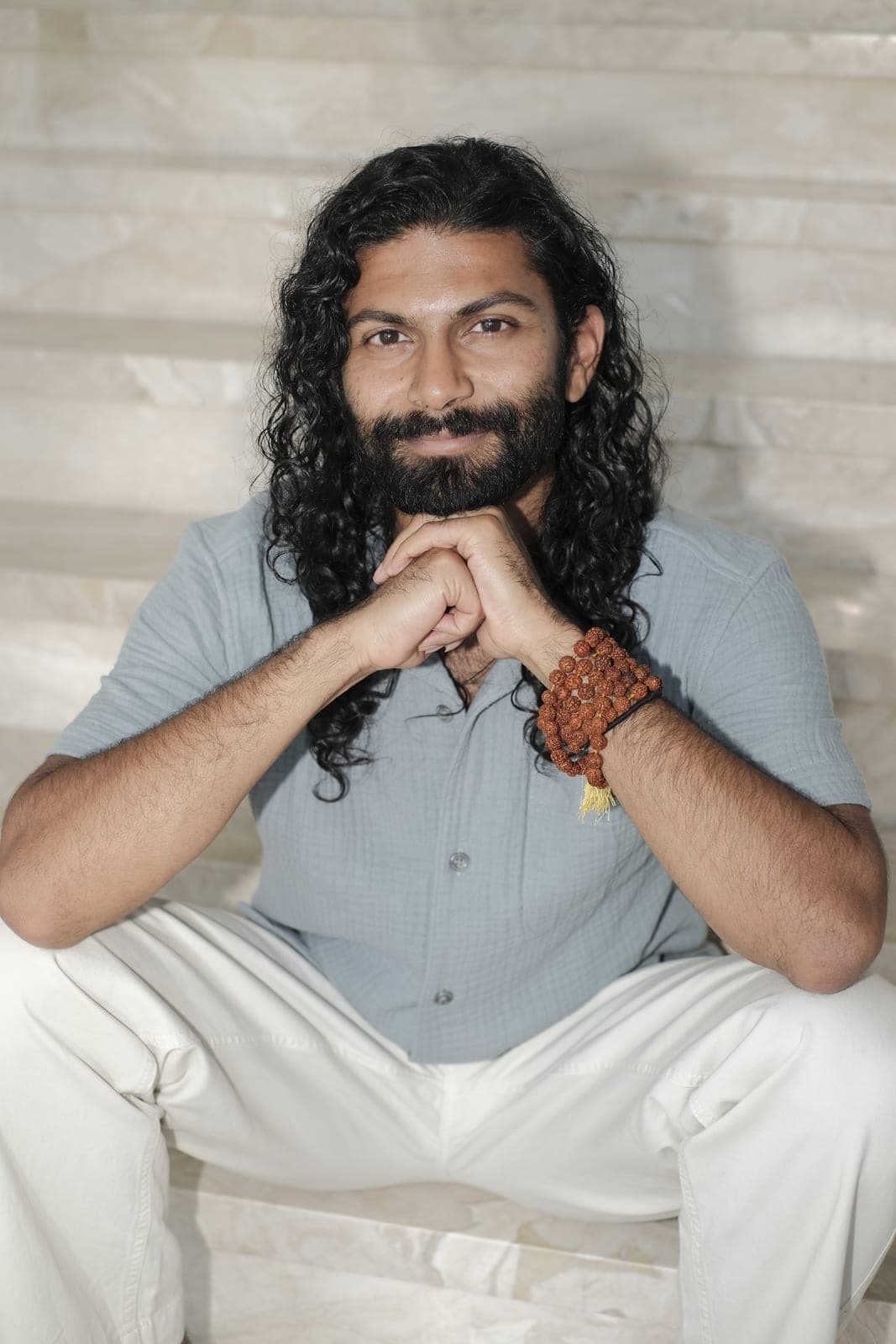
Kedar Shashidhar is a relational leadership advisor, facilitator, and coach who spent nearly a decade in early-stage tech before his attention turned toward the deeper layers of human behavior. His path into relational work combined intensive training in psychological and somatic frameworks with years of apprenticeship within ayahuasca traditions. He's been facilitating Circling and Relatefulness for years, and co-created The Relational Accelerator, a methodology for developing the nervous system capacity to stay present under pressure.
Who are you?
There's no single profile for this. Across every cohort we've run, the people who thrive share one quality, a certain hunger to grow, and a life well lived across multiple worlds. A few types of people tend to find their way into each of our cohorts.
The seasoned seeker
You've already done real work: therapy, retreats, ceremony, maybe some circling or group practice
You have foundational awareness of your own patterns, and your emotional life has become genuinely important to you
Half of your life is competent and out in the world, half of it is tender and inward, and you're excited about peers who are on the path and integrating both
You want peers as serious about waking up as they are about what they are up to in the world
The ripe beginner
You haven't done much formal practice yet, and that's fine. What you have is aliveness.
You've sensed for a while that your emotions matter, and that there's more available in how you connect.
You're hungry to develop an emotional + relational practice in connection with others that allows you to transform your edges.
The practitioner looking for peers
You hold space for others: coaching, therapy, facilitation, teaching, guiding. Maybe you've done it professionally for a while, or maybe you're just getting started.
You're good at it, and you also know the trap of always being the one running the room and are looking for peers to be met by
You want peers at your own depth, developmental friends, not more clients or students
You want to keep growing your own edge, and to practice being a fellow traveler rather than the expert
Ready to Apply?
The application is on the next page, and it asks about your experience and what you're hoping for.
If you are not sure this is for you, talk to one of us first. Book a discovery call
Or come to an intro event.

Emotional and Relational Surfing: Tools for Developmental Friendship
Also happening online: Online Intro to Emotional Surfing.
Mondays 3:00-5:30pm · $20, nobody turned away for lack of funds